
What Mary Poppins Teaches Us About How Banks Really Work
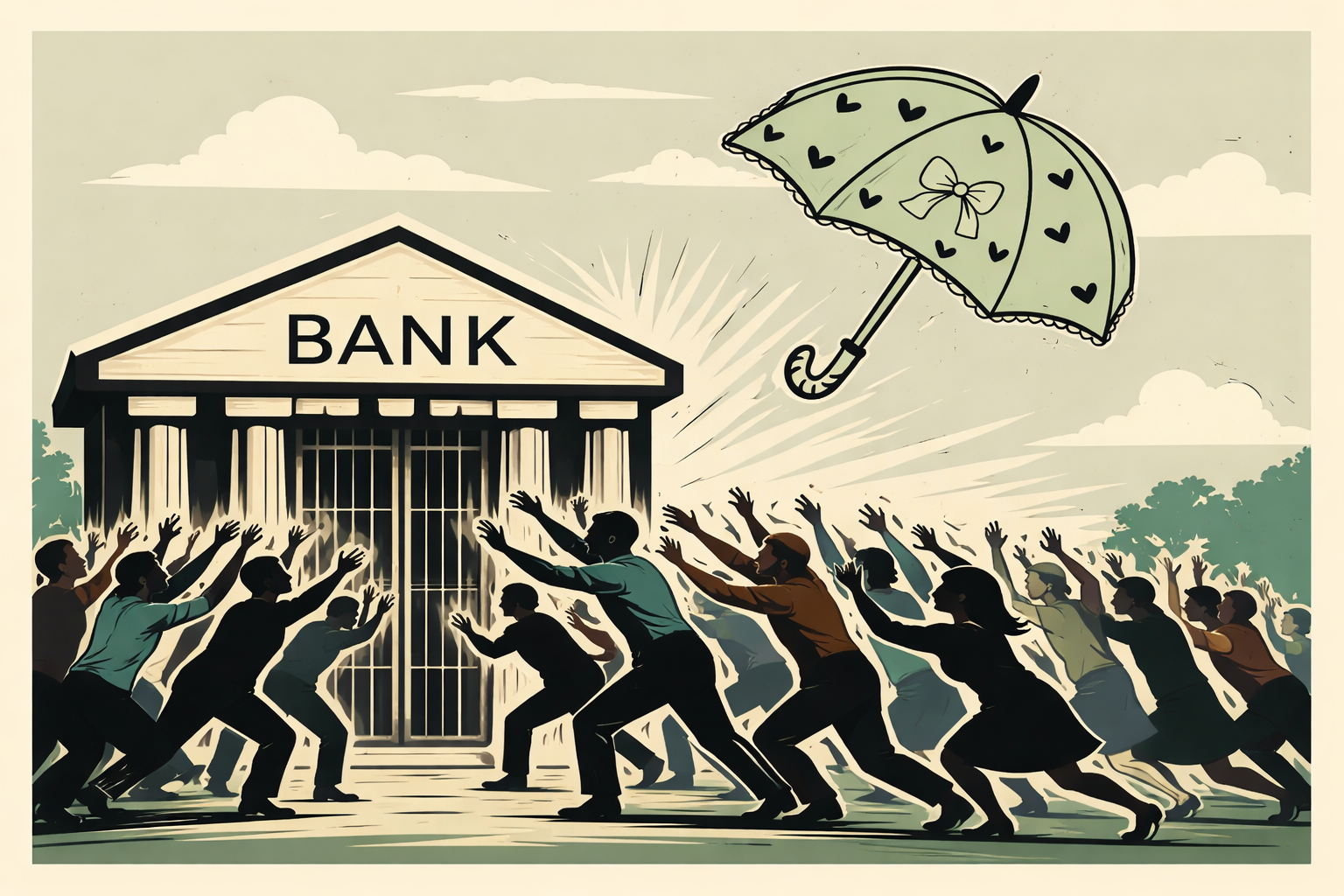
There is a short, almost playful scene in the Mary Poppins movie that explains more about the modern banking system than most economics textbooks ever will.
Mary Poppins takes little Michael Banks to the bank where his father works. It is meant to be a lesson in responsibility. A lesson in prudence. A lesson in being “good with money”.
Michael is encouraged to invest his tuppence, a single penny, “wisely in the bank”, where it will supposedly be safe and sound. Mr Dawes, the senior director, assures him of this with great authority and confidence.
But Michael hesitates.
Intimidated by the stern old banker, confused and overwhelmed, he refuses to hand over his coin. His reaction is small, emotional, and very human. But the consequences are anything but small.
Other customers overhear the exchange. Whispers spread across the marble hall. A simple question begins to ripple through the room:
If this child cannot get his money back, will we be able to get ours?
Panic sets in.
Within moments, depositors rush to the counters, demanding to withdraw their savings. The atmosphere shifts from calm confidence to outright fear. The bank clerks react immediately. The gates are shut. The bars come down. No one gets their money.
The scene is played for laughs.
The lesson behind it is deadly serious.
The Core Promise of Banking
Banks sell us two things at the same time:
Safety and availability.
They promise that your money is safe and that you can access it whenever you need it. We rarely question this promise because it feels intuitive. Of course the bank has my money. Where else would it be?
But this is where the illusion begins.
In reality, banks do not keep everyone’s money sitting in a vault, waiting to be collected. They never have.
Modern banking is built on a structure called fractional reserve banking. In simple terms, this means that banks keep only a fraction of deposits in reserve. The rest is lent out, invested or otherwise put to work.
Your deposit becomes someone else’s loan.
That loan becomes someone else’s income.
That income is deposited again.
And the cycle continues.
This is how banks “create” money. And it works remarkably well – as long as confidence holds and not everybody wants their money back at the same time.
What a Bank Run Really Is
A bank run is often described as mass hysteria. An emotional overreaction. Irrational fear.
That framing is convenient. It places the blame on people rather than on the institution.
In reality, a bank run is not caused by panic alone. Panic merely reveals a structural truth: the money is not actually there.
Banks rely on one key assumption — that not everyone will ask for their money at the same time. As long as withdrawals are staggered and predictable, the system functions. The moment that assumption breaks, even a perfectly “respectable” bank can collapse under the pressure.
This is not a flaw of one bad bank. It is a feature of the system itself.
The Mary Poppins scene captures this perfectly. Nothing fundamentally changes about the bank between the calm moment and the panic. No bad loans suddenly appear. No fraud is uncovered. What changes is confidence.
And confidence is the real foundation of modern banking.
Why This Keeps Happening
History has repeated this lesson again and again.
From the Great Depression, to savings and loan crises, to 2008, to more recent regional bank failures, the pattern is always the same. As long as trust remains intact, the system hums along quietly. When trust breaks, liquidity vanishes. Your money is gone.
Deposit insurance, central bank backstops and emergency liquidity facilities exist precisely because this structure is inherently fragile. They are not signs of strength. They are safety nets designed to prevent confidence from collapsing entirely.
Mary Poppins turns this into a children’s story.
History turns it into recurring financial crises.
Why This Matters for You
Understanding how banks work is not about fear or doom. It is about clarity.
Money in a bank account is not the same as cash in your hand. It is a claim. A promise. A liability on a bank’s balance sheet. Most of the time, that distinction does not matter. Sometimes, it matters a great deal.
Financial literacy is not about memorizing interest formulas or learning how to calculate percentages. It is about understanding incentives, structures and assumptions.
The Mary Poppins scene had always stayed with me, because it exposes something uncomfortable: the system works until it doesn’t, and when it doesn’t, the rules change very quickly.
The gates close.
The bars come down.
And suddenly, access is no longer guaranteed. And then it gets really ugly.
Final Thought
Banks are not evil. They are not villains in a children’s movie.
They are institutions built on trust, leverage and collective belief. When belief holds, the system feels invisible. When belief cracks, its mechanics become impossible to ignore. Not having access to money is no joke.
Mary Poppins shows us this in under two minutes.
The question is not whether banks work.
They do.
The real question is whether you understand how — and what that means for your relationship with money.
If you want to truly understand money, banking and the systems that shape your personal every-day financial life, the Mystery Money course breaks these concepts down calmly, clearly and step by step.
